Research Themes
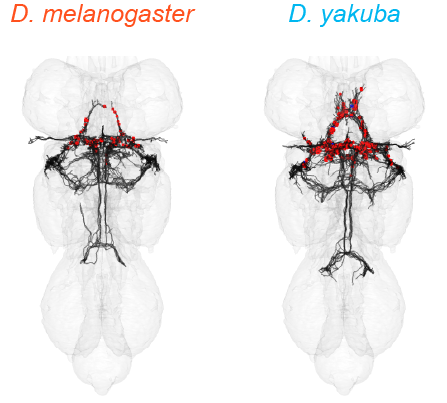
Linking evolutionary circuit rewiring to neural dynamics and behavior
Animal behaviors are remarkably diverse across species, yet how neural circuits evolve to generate this diversity remains poorly understood. We address this question using Drosophila courtship song, investigating how evolutionary changes in circuit connectivity contribute to species-specific song repertoires in D. melanogaster and D. yakuba. By combining comparative connectomics, cell-type-specific neural manipulation, in vivo neurophysiology, and computational modeling, we examine how changes in neural wiring reshape premotor circuit dynamics and behavior.

Circuit mechanisms of behavioral stability and flexibility across evolution
Animals must balance behavioral stability with evolutionary flexibility: while essential behaviors such as locomotion remain conserved across species, others, such as courtship, can diversify rapidly. Using Drosophila wing premotor circuits, we investigate how neural circuits maintain stable functions while evolving new behavioral outputs. By comparing the circuits underlying conserved and species-specific wing behaviors between D. melanogaster and D. yakuba, we aim to uncover the circuit mechanisms that enable behavioral innovation without compromising essential motor functions.
Developmental programs shaping species-specific circuit assembly
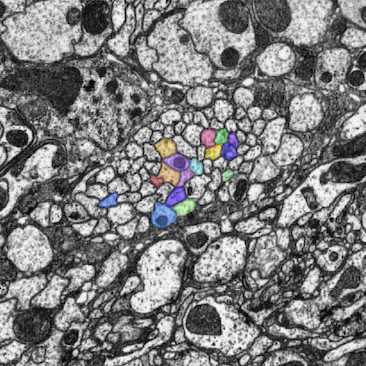
Evolutionary changes in developmental programs can reshape neural circuit assembly, leading to differences in circuit function and behavior across species. By focusing on cell types that exhibit species-specific differences in morphology and connectivity between D. melanogaster and D. yakuba, we investigate the molecular and cellular mechanisms that generate species-specific wiring patterns in courtship song circuits. Our goal is to understand how developmental programs evolve to produce new circuit architectures and behavioral diversity.